
Our Latest Blogs
Plastic Seals Manufacturers in Vasai East, Palghar
Our Latest Blogs August 21, 2026Security Seals Manufacturers in Vasai East, PalgharOur Latest Blogs July 30, 2026Container Seal Dealers in
Security Seals Manufacturers in Vasai East, Palghar
Our Latest Blogs Categories Plastic Seals → Wire Seals → Cable Seals → Bolt Seals → The Importance of Choosing
Container Seal Dealers in Vasai East, Palghar near me
Our Latest Blogs Categories Plastic Seals → Wire Seals → Cable Seals → Bolt Seals → Container Seal Dealers in
Categories
How to Choose Security Seals: The Ultimate Guide for Supply Chain Integrity
Selecting the right tamper-evident or high-Security Seal is a critical decision for logistics managers, export-import professionals, and security heads. Security Seals do more than just lock a door; they act as the primary defense against theft, provide a clear audit trail for compliance, and immediately flag unauthorized access.
Understand the Primary Purpose of Your Security Seal
Before evaluating specific materials or locking mechanisms, you must define exactly what you need the seal to achieve. Security Seals generally fall into two strategic categories: Indicative (detecting unauthorized entry) and Barrier (physically preventing entry).
Key Security Objectives to Evaluate:
- Tamper Evidence: Flagging physical manipulation attempts instantly through visual distortion, color changes, or structural fractures.
- Theft Prevention: Creating a heavy physical barrier that requires specialized industrial cutting tools to remove.
- Chain of Custody Tracking: Providing a definitive paper trail using laser-etched identifiers that cannot be wiped away or altered.
- Regulatory Compliance: Meeting international customs requirements to ensure your cargo passes through borders smoothly without costly inspection delays.
- Brand Protection: Preventing product adulteration, dilution, or counterfeiting in sensitive industries like pharmaceuticals, chemicals, and high-end consumer goods.
Decode the Three Main Security Levels (ISO 17712 Classification)
International logistics standards categorize seals into three distinct levels based on their physical strength, tensile capacity, and resistance to tampering. Understanding these classifications is essential when learning how to choose Security Seals for global trade.
The Standard Classifications:
Indicative Seals (I):
- Manufactured primarily from lightweight plastics or thin wire.
- Designed exclusively to show clear visual evidence of tampering.
- Can be broken easily by hand or with standard household scissors.
- Perfect for short transit cycles, internal inventory control, and low-risk environments.
Security Seals (S):
- Built using intermediate materials like heavier plastics, laminated metals, or thin aircraft cables.
- Provide a higher level of structural resistance than indicative seals.
- Require basic tools like wire cutters or heavy shears for removal.
- Commonly deployed for local truck distribution, utility meters, and warehouse storage.
High-Security Seals (H):
- Constructed from rugged, heavy-duty materials like galvanized steel, stainless steel, and high-tensile carbon steel strands./li>
- Strictly regulated under ISO 17712 standards to resist structural attacks, pulling, bending, and shearing forces.
- Require massive, industrial-grade bolt cutters or cable cutters to open.
- Mandatory for international shipping containers, cross-border rail freight, and high-value cargo transport.
Analyze the Core Security Seal Categories
Different shipments demand different structural form factors. Matching the seal category to your specific locking latch or locking mechanism ensures the security device functions perfectly without slipping or failing.
Plastic Seals
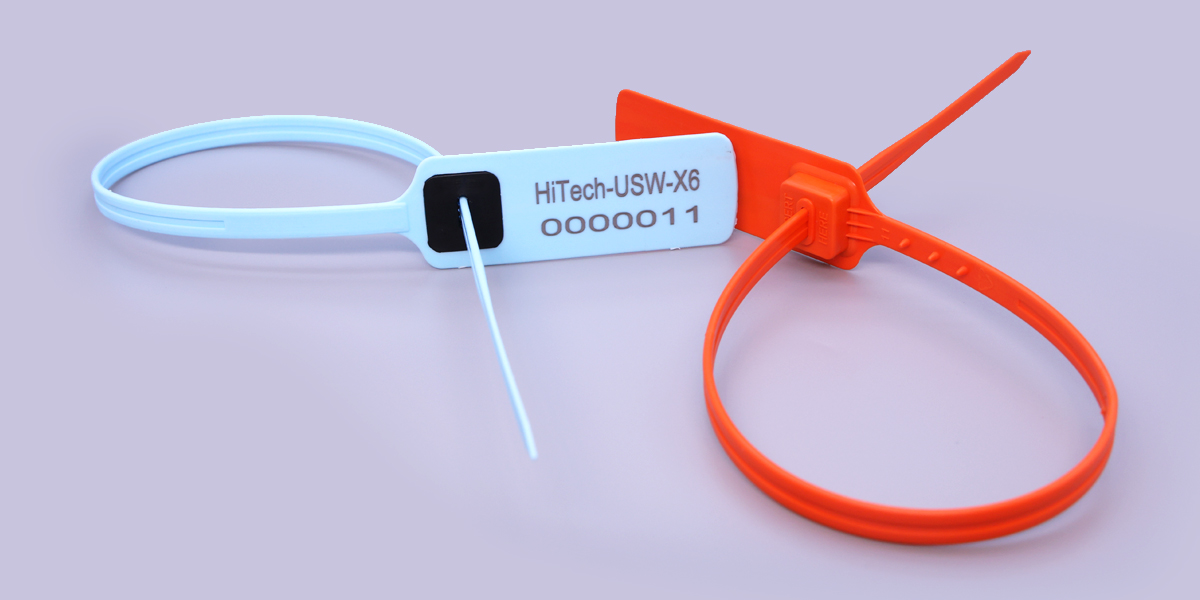
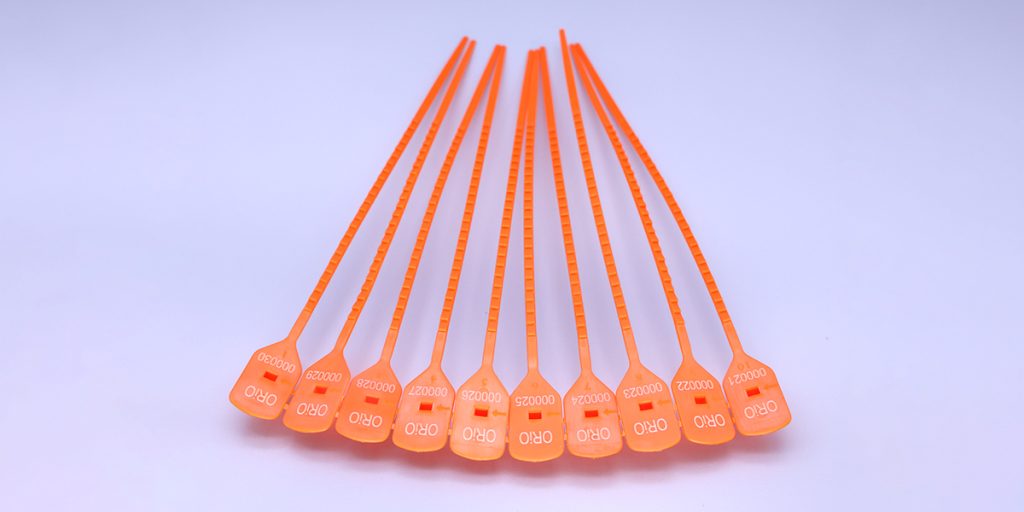
Plastic seals offer an economical, highly versatile solution for non-heavy freight. They are single-use, lightweight, and can be customized with high-visibility colors for rapid visual inspection.
Pull-Tight / Variable Length Seals:
- Feature a smooth or notched strap that pulls through a locking chamber, mimicking a heavy-duty zip tie.
- Allow users to cinch the seal down tightly against the locking point to prevent shifting.
- Ideal for securing airline catering trolleys, fire extinguishers, emergency medical kits, and courier bags.
Fixed-Length Ring Seals:
- Form a loop of a predetermined, non-adjustable size once clicked into place.
- The locking mechanism is completely enclosed inside a capsule, protecting it from manipulation or picking tools.
- Highly reliable for over-the-road truck trailer doors where regular movement can strain variable-length ties.
Padlock-Style Plastic Seals:
- Feature a rigid plastic body with a thin wire or plastic shackle shaped like a traditional padlock.
- Can be applied rapidly using one hand, making them highly efficient for fast-paced logistics hubs.
- Frequently used to secure hospital carts, duty-free carts, and utility junction boxes.
Wire Seals
Wire seals combine a compact body (often acrylic or metal) with a flexible, braided wire strand. They are engineered for tight, intricate locking points where rigid seals cannot fit.
Key Design Elements:
- Utilize a transparent or semi-transparent outer body that allows inspectors to visually confirm the inner locking mechanism is fully engaged.
- The wire can be threaded through tiny apertures, pinholes, and uneven latch systems.
- Once the wire is twisted or crushed inside the body, it cannot be backed out without destroying the seal.
Primary Technical Applications:
- Utility Infrastructure: Securing electricity meters, water valves, gas pipelines, and digital control panels.
- Industrial Logistics: Sealing chemical storage drums, fuel tanker valves, calibration equipment, and sampling bottles.
Bolt Seals
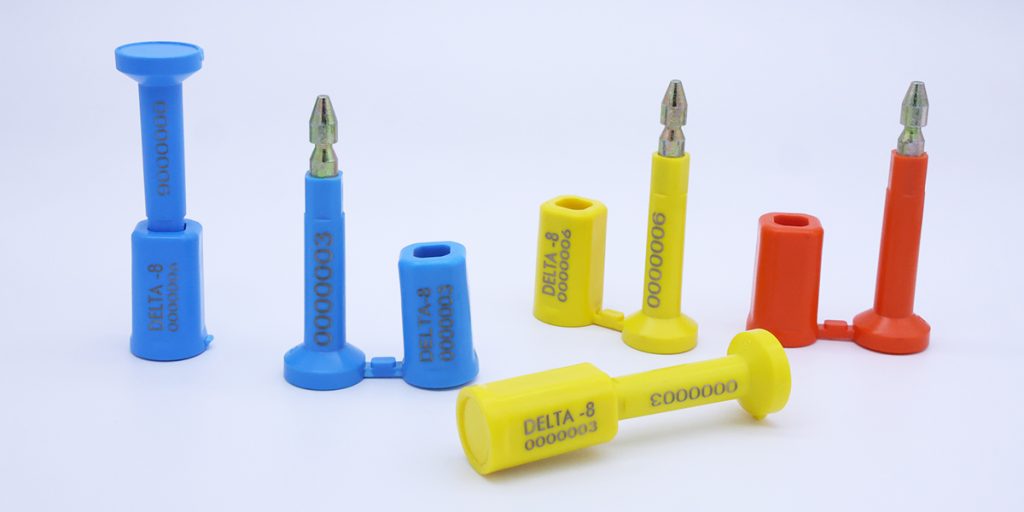
Bolt seals represent the pinacle of heavy-duty physical barrier security. They consist of a solid metal pin and a matching locking cap that lock permanently together upon application.
Technical Specifications:
- Engineered with an anti-spin design to prevent high-speed rotational attacks (where criminals try to spin the bolt out of its locking housing).
- Both the bolt pin and the locking bush are laser-engraved with matching serial numbers to prevent component swapping.
- Typically coated in high-impact plastic to protect the steel core from corrosion and to display bright, scannable asset identifiers.
Primary Technical Applications:
- Intermodal ocean freight shipping containers (locking the door keeper bars).
- Cross-border long-haul box trucks and refrigerated trailers.
- Railway boxcars and bulk cargo transport units.
Cable Seals
Cable seals utilize a flexible, non-preformed aircraft cable attached to an aluminum alloy or steel locking block. They provide an adjustable-length option with heavy-duty barrier strength.
The Non-Preformed Advantage:
- Crucially, when a non-preformed cable is cut, the individual steel strands unravel completely.
- This structural unraveling makes it physically impossible to re-splice, glue, or slide the cable back into the locking head, eliminating a common method of covert cargo tampering.
Primary Technical Applications:
- Securing asymmetrical locking latches that do not align perfectly for a rigid bolt seal.
- Locking heavy machinery, industrial roll-up doors, valve handles, and high-value flatbed tarp lines.
Match the Seal Variant to Your Specific Asset Type
Deploying the wrong seal variant on an asset compromises your entire security perimeter. Use this breakdown to align your physical assets with the correct security hardware.
Intermodal Ocean Shipping Containers:
- Recommended: ISO 17712 High-Security Bolt Seals or High-Tensile Cable Seals (3mm to 5mm thickness).
- Reasoning: These assets face harsh, unmonitored ocean transits and must meet international customs frameworks.
Commercial Trucks, Box Trailers, & Logistics Vans:
- Recommended: Fixed-Length Plastic Seals, Heavy-Duty Pull-Tight Plastic Seals, or Low-Diameter Cable Seals.
- Reasoning: These vehicles require fast, frequent seal checks during multi-stop hub distribution rounds.
Chemical Tanks, Liquid Bulks, & Fuel Tankers:
- Recommended: Stainless Steel Wire Seals or Corrosion-Resistant Cable Seals.
- Reasoning: The locking points are frequently exposed to chemical vapors, moisture, and road salt, which break down low-grade plastics.
Industrial Drums, Barrels, & Storage Totes:
- Recommended: Twister-Style Wire Seals or Flexible Pull-Tight Plastic Seals.
- Reasoning: Drums utilize ring clamps with tiny alignment holes that require flexible, low-gauge sealing filaments.
Courier Packages, E-commerce Bags, & Document Totes:
- Recommended: Tamper-Evident Pull-Tight Plastic Seals with integrated tearing claws.
- Reasoning: High-velocity sorting facilities require tool-free, hand-rippable removal options that still guarantee single-use integrity.
Evaluate the Operational and Transit Environment
A Security Seal that performs perfectly in a climate-controlled warehouse might crack, snap, or degrade when subjected to real-world transit conditions. Your selection process must account for the physical realities of the route.
Environmental Variables to Assess:
Thermal Extremes:
- Standard commercial plastics can become brittle and fracture in extreme sub-zero conditions (e.g., cold-chain storage or Siberian winter transit).
- Conversely, extreme desert heat or proximity to industrial engines can soften low-grade polymers, causing the inner locking teeth to slip.
- Solution: Specify engineered nylon or polycarbonate compounds for high-thermal stress routes.
Chemical and Marine Exposure:
- Saltwater exposure during ocean voyages accelerates rust on standard carbon steel, hiding tampering indicators under a layer of corrosion.
- Solution: Use galvanized, stainless steel, or plastic-molded outer coatings for marine, offshore, and chemical logistics.
Mechanical Stress and Vibration:
- Long-distance rail freight and rough road transport generate continuous, high-frequency vibrations that can wear down internal locking springs.
- Solution: Deploy rigid bolt designs or high-tensile braided cables that absorb heavy kinetic energy without backing out.
Implement Modern Traceability & Identification Features
A Security Seal is only as good as the data associated with it. Modern logistics ecosystems rely on advanced surface marking to automate data capture and eliminate human recording errors.
Identification Enhancements:
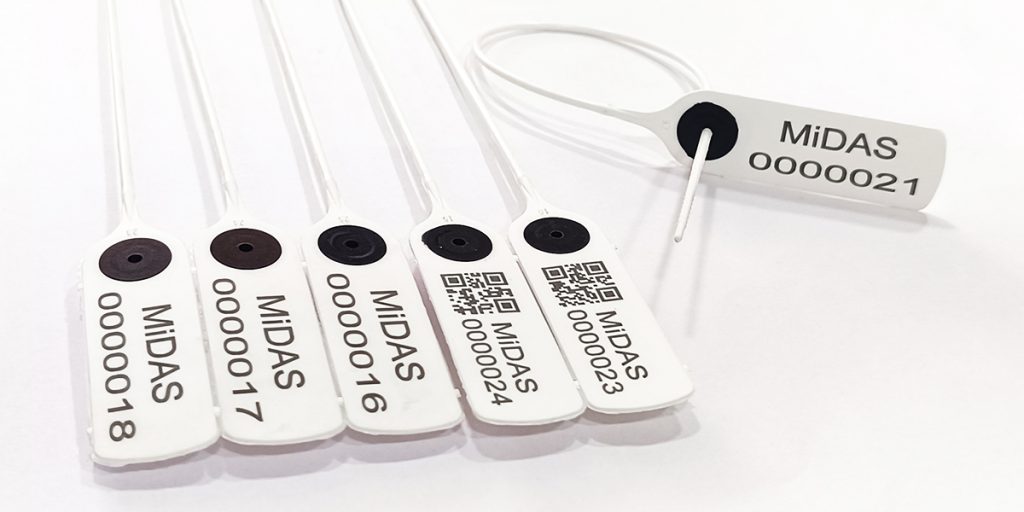
Laser-Etched Serial Numbers:
- Laser marking burns characters directly into the seal material.
- Unlike printed inks, laser etching cannot be scraped away, dissolved with chemical solvents, or replaced without leaving an obvious physical scar on the seal body.
Barcodes and QR Codes:
- Enables warehouse staff to instantly capture the seal’s unique ID using hand-held scanners or mobile apps.
- Speeds up loading dock operations, reduces transcription errors, and automates digital shipping manifests.
Custom Corporate Logos and Color Coding:
- Printing your company’s official logo directly onto the seal makes it highly difficult for bad actors to buy standard off-the-shelf replacements to conceal a break-in.
- Using distinct, rotating color schemes across different shifts, facilities, or days of the week allows gate security to instantly spot an out-of-sequence seal.
Verify Compliance with Global Regulatory Standards
When shipping goods internationally, compliance isn’t optional—it’s a strict legal necessity. Using non-compliant seals can result in seized cargo, heavy fines, and extended border delays.
Critical Regulatory Frameworks:
ISO 17712 Certification:
- The definitive global standard for the testing and classification of mechanical freight container seals.
- To achieve this certification, seals must undergo independent laboratory testing assessing tensile, shear, bending, and impact strength.
C-TPAT (Customs-Trade Partnership Against Terrorism):
- A voluntary supply-chain security program led by U.S. Customs and Border Protection.
- It strictly mandates that all U.S.-bound maritime containers use certified ISO 17712 High-Security (“H” Class) seals.
AEO (Authorized Economic Operator):
- The European Union and international equivalent to C-TPAT, focusing on robust security protocols and verifiable tamper-evident procedures at every stage of logistics.
Establish a Strict Seal Management Protocol
Even the most advanced, expensive Security Seal will fail to protect your cargo if your team does not handle it correctly. Security is a continuous operational process, not just a physical hardware piece.
Best Practices for Your Operation:
Step 1: Secure Storage and Log Control
- Store all unapplied seals in a locked, restricted-access room.
- Maintain a digital log tracking the serial number, the name of the employee who withdrew the seal, the date, and the specific container or vehicle ID it was assigned to.
Step 2: Correct Application Procedures
- Inspect the seal before application to ensure there are no manufacturing defects, hairline cracks, or scuffs on the numbers.
- Pass the seal through the locking latch completely, ensuring it snaps home firmly. Give it a forceful physical pull to verify the internal locking rings have fully locked into place.
Step 3: Verification at Transit Checkpoints
- At every transition point (gate exits, intermodal transfers, arrival docks), gate security must physically inspect the seal.
- They must visually match the physical serial number on the seal against the shipping documentation or digital manifest.
Step 4: Systematic Tamper Inspection
- Before cutting a seal off, inspectors should look for classic signs of tampering: glue residues, stress whitening on plastics, scratch marks near the locking chamber, or mismatched serial numbers on the bolt pin versus the cap.
- Document the removal process with mobile photographs for archival security records.
Frequently Asked Questions (FAQ) :
Q1: How do I know if a Security Seal has been tampered with?
Ans : Look for visible signs like stress whitening on plastic, glue residue, scrape marks near the locking chamber, or a serial number that does not match the shipping manifest.
Q2: What is the main difference between an indicative seal and a high-Security Seal?
Ans : Indicative seals are lightweight plastic tools designed only to show visual evidence of entry, while high-Security Seals are heavy metal barriers built to physically resist theft.
Q3: Why must a high-security bolt seal be ISO 17712 certified?
Ans : This certification proves the seal has passed independent laboratory tests for physical strength, making it legally compliant for international shipping and customs clearance.
Q4: Can Security Seals be reused once they are cut off?
Ans : No, all professional Security Seals are engineered for single-use only and are physically destroyed or permanently deactivated upon removal.
Q5: Why is laser etching preferred over standard ink printing on Security Seals?
Ans : Laser etching burns numbers directly into the material, meaning the tracking identifiers cannot be wiped away with chemicals or scraped off without destroying the seal body.
Connect With Our Security Experts
 Website: https://protoseals.com/
 Phone: +91 8793853797
 Email: sales@protoseals.com
 Address: B-14, Princess Apt., Vrindavan Complex, Evershine City Gate, Vasai Road (East), Palghar: 401208. Maharashtra. India.
Conclusion: Partner with an Expert Manufacturer
Learning how to choose Security Seals comes down to balancing structural strength, tracking requirements, and regulatory mandates. Cutting corners with low-grade, uncertified seals leaves your business vulnerable to massive inventory losses, insurance claim rejections, and damaged client relationships.
Partnering with an established, trusted manufacturer ensures you get the engineering precision your supply chain demands. At Protoseals, we engineer and manufacture a complete lineup of high-performance plastic, wire, cable, and bolt seals that strictly comply with international standards. From custom laser-etched branding to advanced barcoding, we provide the traceability your logistics network needs to move goods safely around the world.